-

29 June: Understanding and Responding to Online Graphic and Extreme Violent Content. James March
Graphic and extreme violence content is becoming increasingly visible and accessible across the internet, driven by platform algorithms, niche online communities, and the rapid sharing of unmoderated material. Despite this growth, research and professional training in this space remains limited, leaving many practitioners underprepared to understand, respond to, or support young people exposed to such…
-

23 June: Histories of Terrorism Conference
The Handa Centre for the Study of Terrorism and Political Violence at the University of St Andrews is hosting a major event in June 2026 on the Histories of Terrorism conference on 23 June. Given the upturn in historical scholarship on terrorism, the conference will be an opportunity to discuss how to better articulate the specificity…
-
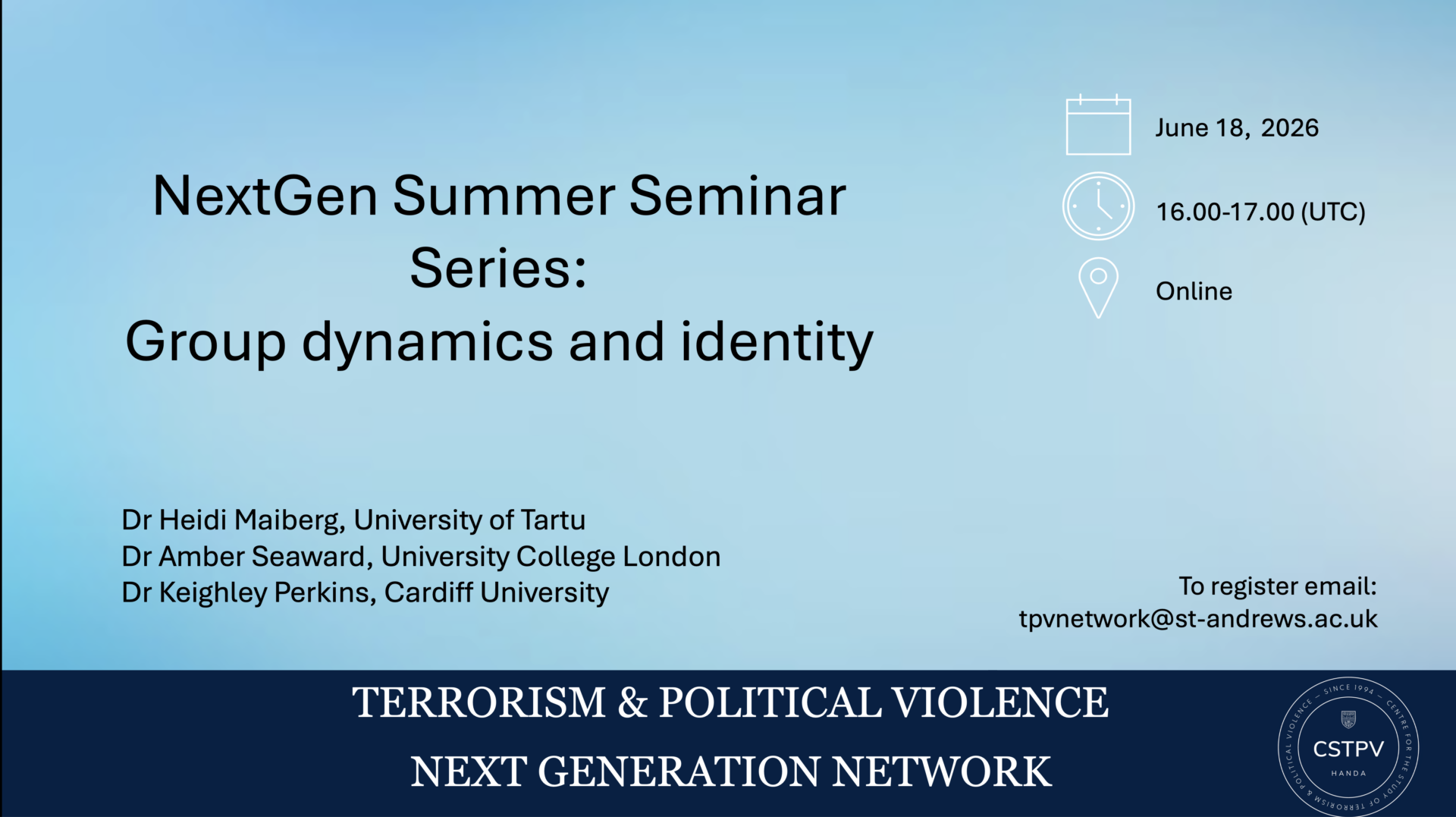
18 June: TPV NextGen Seminar Series: Group Dynamics and Identity
The second of two online panels from the Terrorism and Political Violence Next Generation Network, organised by the Handa Centre for the Study of Terrorism and Political Violence at the University of St Andrews. The series brings together early career researchers working at the cutting edge of research on terrorism and political violence. — 📅…
-

13 May: TPV Next Gen Seminar Series: Technology and Extremism
The first of two online panels from the Terrorism and Political Violence Next Generation Network, organised by the Handa Centre for the Study of Terrorism and Political Violence at the University of St Andrews. The series brings together early career researchers working at the cutting edge of research on terrorism and political violence. — 📅…
-

28 May: Addressing Violent Radicalisation and Extremism: A restorative justice, psychosocial approach. Prof Theo Gavrielides
In this talk, Professor Gavrielides will share insights from his work on restorative justice, which opens up new possibilities to address the challenges facing current models for preventing and controlling violent radicalisation and extremism. Gavrielides taps into the combined strengths of restorative justice, positive criminology, and positive psychology to set out a new model for prevention and control of…
-

29 April: Before the Attack: What We Are Learning About Preventing Public Violence. Paul Wilkinson Memorial Lecture with Prof Jessica Stern
Public violence, including mass public shootings and terrorist attacks, accounts for a very small fraction of overall homicide, yet it produces an outsized psychological and social impact, reshaping how people experience public space, safety, and one another. The radius of psychological injury far exceeds that of physical harm. Research shows that warning signs are often…
-

28 April: Responding to Terrorism and Extremism in Scotland: Needs and Priorities. Dr James Lewis, Dr Sarah Marsden
This session will discuss the findings of a recent project funded by the Scottish Council on Global Affairs (SCGA) which examined the needs and priorities of researchers, policymakers and practitioners working on issues relating to counter-terrorism (CT) and countering violent extremism (CVE) in Scotland. Drawing on a review of relevant literature and a small-scale survey…
-

27 April: The Only Way is Ethics: Next Gen Networks Unite
The University of Southampton’s Centre for Criminology in the Digital Age is Excited to Convene an Event Dedicated to Supporting the Next Generation of Researchers Working at the Cutting Edge of Sensitive, Ethically Complex Research. This Session Brings Together Leading Research Centres and Networks Committed to Fostering Community, Sharing Resources, and Strengthening Ethical Practice Across…
-
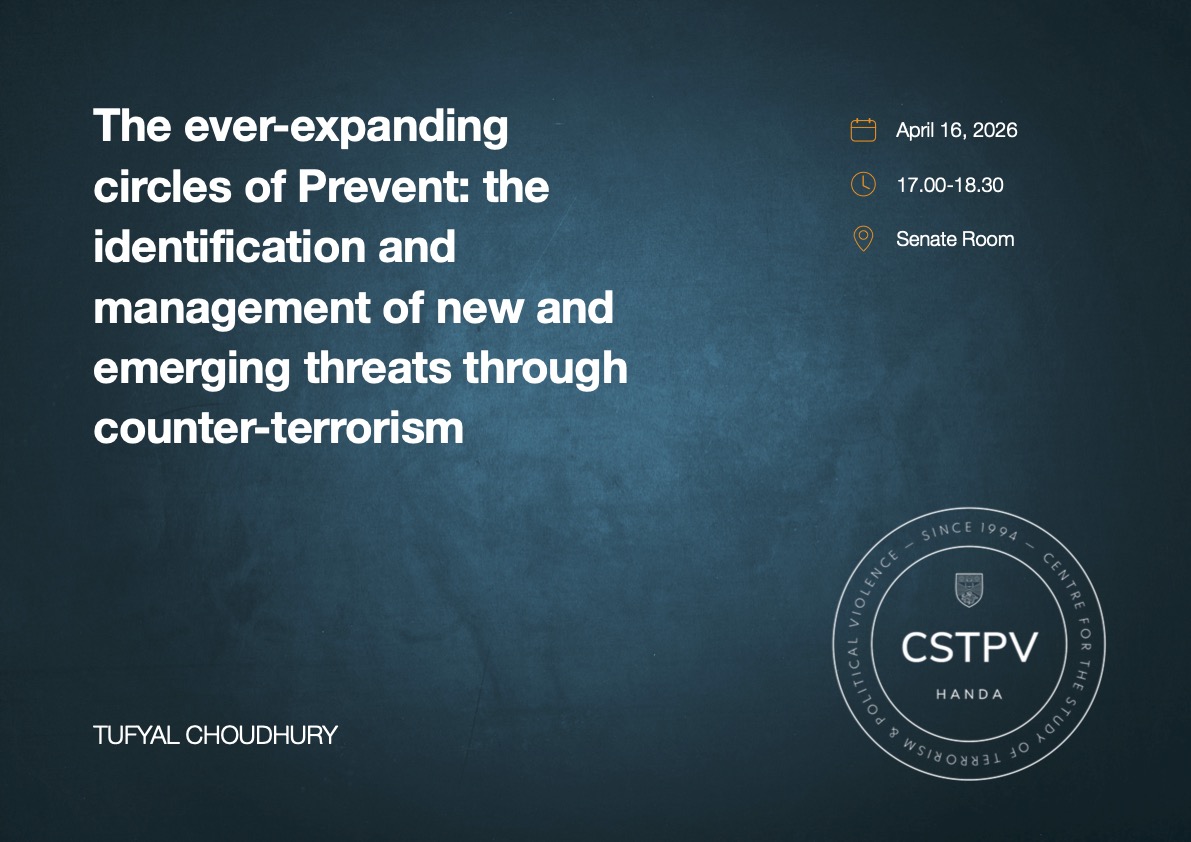
16 April: The ever-expanding circles of Prevent: the identification and management of new and emerging threats through counter-terrorism. Dr Tufyal Choudhury
Tufyal will analyse how UK counter-terrorism has expanded to address extreme violence that falls outside established definitions of terrorism. Focusing on the 2024 Southport killings, it examines the Prevent programme’s shift from targeting ideological extremism to managing individuals characterised by fragmented beliefs, personal grievance, or fascination with violence. Drawing on Prevent referral data and recent…
-
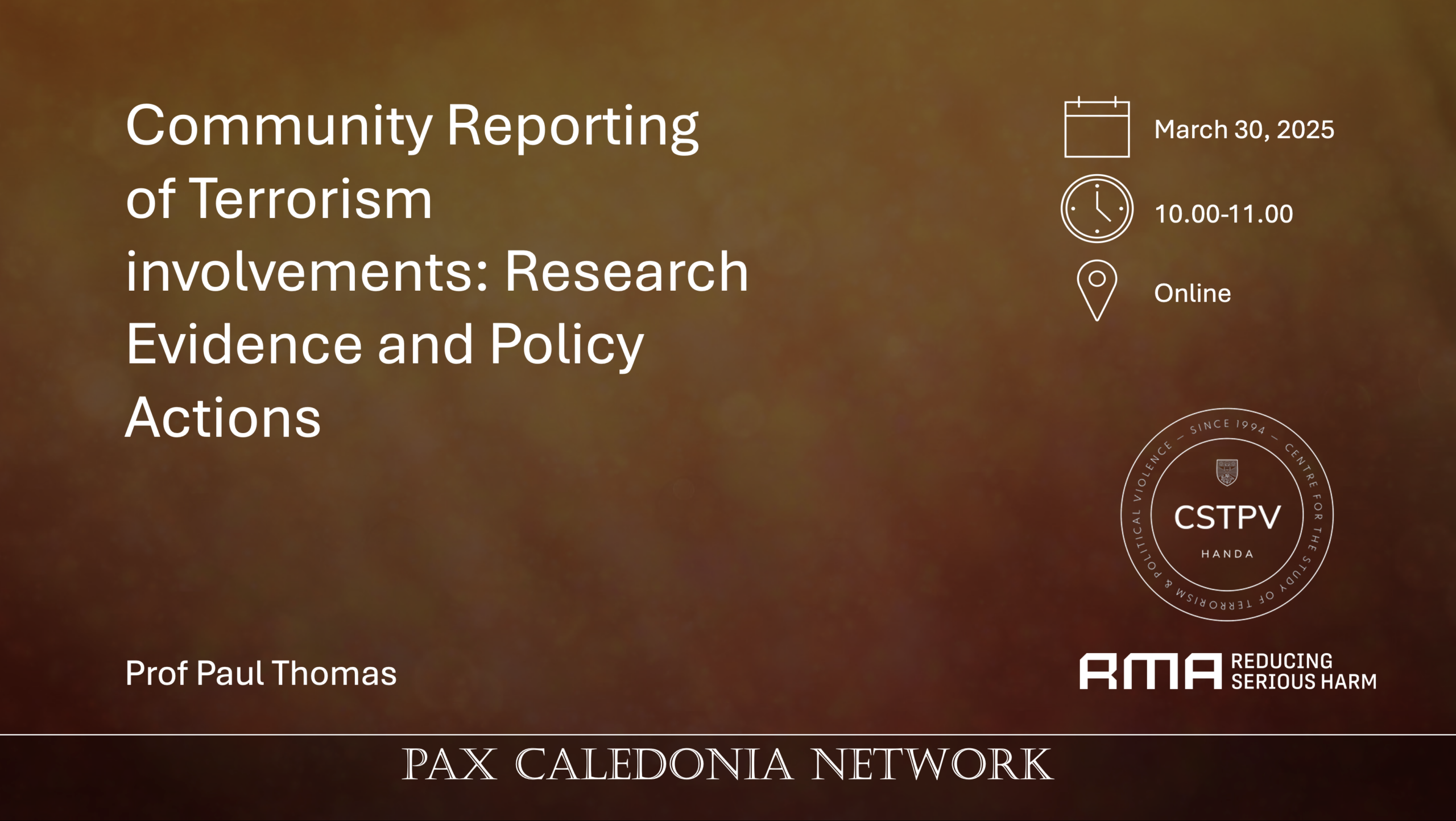
30 March: Community Reporting of Terrorism involvements: Research Evidence and Policy Actions. Prof Paul Thomas
Research evidence shows that terrorist actors often ‘leak’ their intent towards planning and carrying out terrorist violence to those close to them – partners, family members or close friends (Gill et al, 2014), just as perpetrators of other types of mass targeted violence, such as ‘school shooters’, do. These ‘intimate bystanders’ are thus often the…
-

30 March: AI as an Accelerator in Terrorism and Extremism Research
The rapid integration of artificial intelligence into digital spaces has reshaped the landscape of terrorism and extremism research. This talk explores the opportunities and challenges of applying data science, machine learning, and generative AI within the field. It offers an overview of conventional data science approaches alongside newer generative techniques, and considers how social science methods can…
-

26 March: If It’s Not a Bug, It’s a Feature: How the normalization of hate speech has made games vulnerable to extremism. Dr Rachel Kowert
What happens when hate speech becomes so routine in a cultural space that it’s treated as unremarkable background noise? This talk examines how digital gaming environments have normalized extreme hate speech (particularly misogyny) to the point where it is often dismissed as “just part of gaming culture.” Drawing on recent research, I’ll trace how this…
-
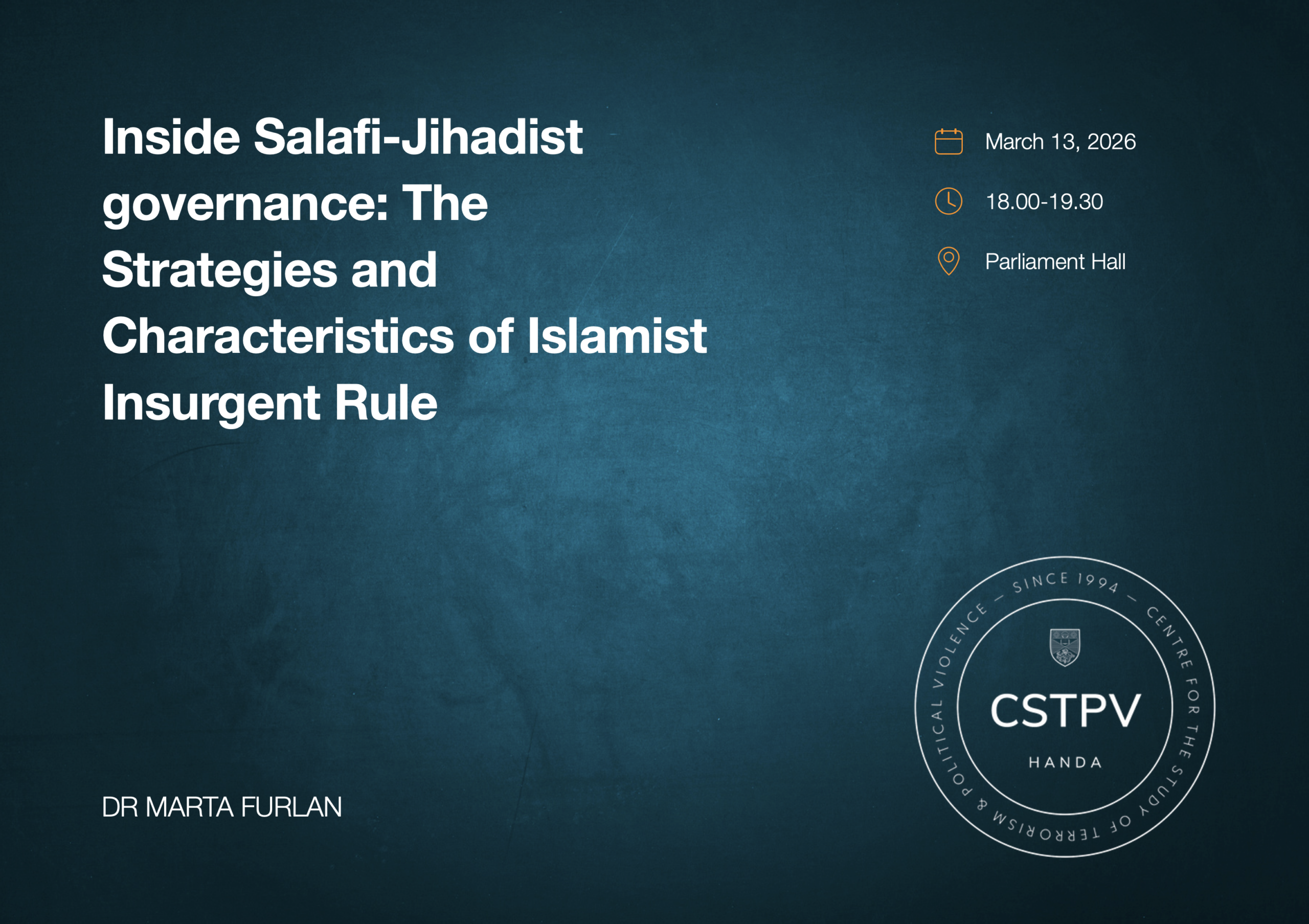
13 March: Inside Salafi-Jihadist governance: The Strategies and Characteristics of Islamist Insurgent Rule. Dr Marta Furlan
In the years following the Arab Spring, a number of Islamist insurgent groups conquered swaths of territory across the Middle East and North Africa and began governing civilian populations. These groups have been faced with the complexities of administering justice, collecting taxes, and providing public services such as health care and education. How do Salafi-jihadist…
-
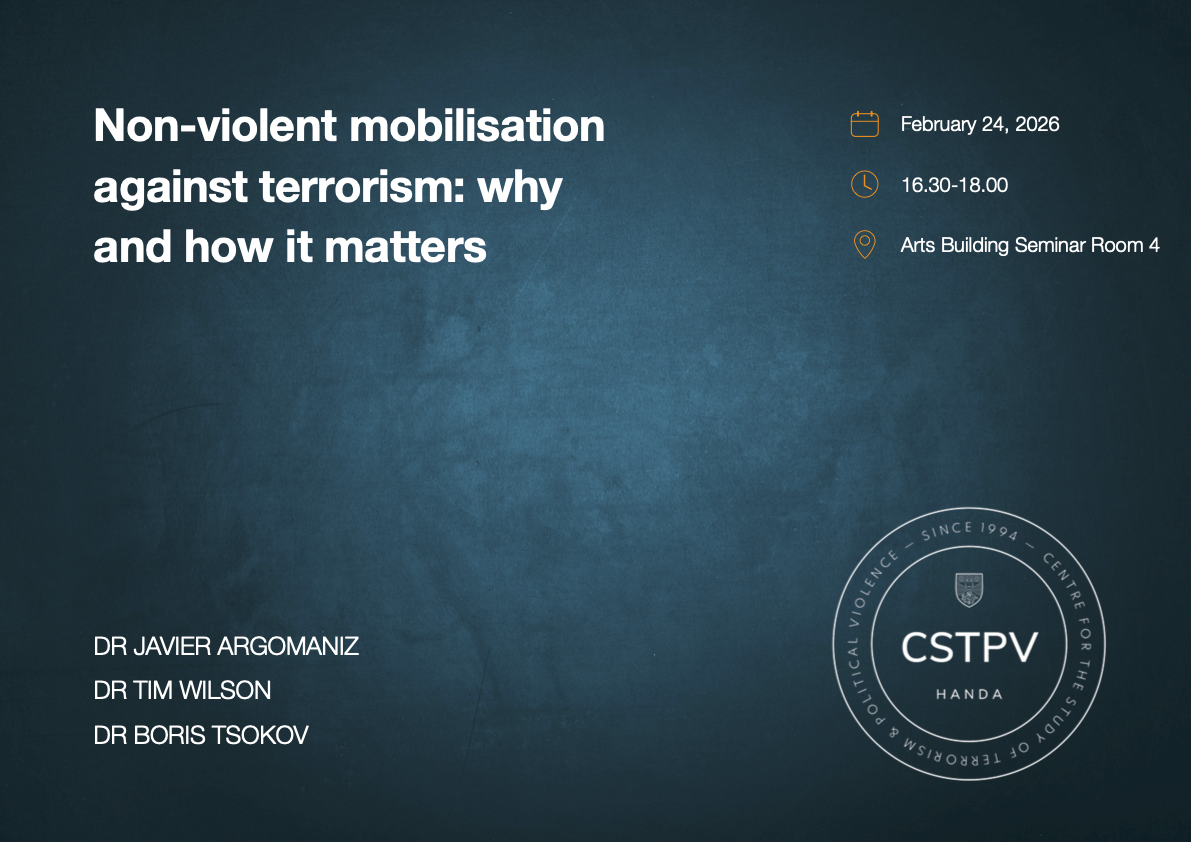
24 February: Non-violent mobilisation against terrorism: why and how it matters. Dr Argomaniz, Dr Wilson, Dr Tsokov
When studying terrorist campaigns, analysis typically centres on the two principal protagonists: the state and militant organisations. This narrow focus reflects a persistent assumption that, in moments of political exigency, violence constitutes the most effective instrument for achieving social and political change, rendering non-violent alternatives naïve or ineffective. This roundtable challenges that assumption by examining…
-

19 February: Gendered grievances and the logic of violence. Dr Anne Peterscheck
This presentation explores how gendered grievances shape both everyday and extremist forms of violence, drawing on research into perpetrators of domestic abuse and online incel communities. Though usually treated as distinct issues, both groups share similar narratives: that men are entitled to control women and that violence can restore a lost status or authority. Findings…
Terror Through Time
A BBC radio show on terrorism and political violence through the ages. The show includes interviews from CSTPV academics.
Series 1
Napoleon and the Birth of Terror
The Fenian Dynamiters
No Future – The Great Anarchist Scare
Empires Crumble
Stirring the Middle East
Murderous Mandate
The British Way
Killers in the Casbah
The Return of the Gunmen
Defeat From the Jaws of Victory- ETA
Hijack
Carlos and International Terror
State of Terror
Six Against Sixty Million
Africa Erupts
Series 2
Mossad- The Wrath of God (24/11/14)
State Sponsored Killers (25/11/14)
Afghan Dawn (26/11/14)
Tiger, Tiger (27/11/14)
Northern Ireland- The End Game (28/11/14)
Beirut- City of Terror (1/12/14)
Deathwish- Battling Suicide Bombers (2/12/14)
Mujahedeen On Tour (3/12/14)
Laying Down The Law (4/12/14)
The New Face of Terror? (5/12/14)
Paul Wilkinson Memorial Lecture Series
The annual lecture in honour of the CSTPV founder, Professor Paul Wilkinson, CBE.
2026
Prof Jessica Stern
Before the Attack: What We Are Learning About Preventing Public Violence
2025
Prof John Horgan, Georgia State University
The Recruiters
2024
Dr Sophie Haspeslagh, King’s College London
The Linguistic Ceasefire or how to re-engage listed armed groups
2022
Dr Raphaël Lefèvre, New College, University of Oxford
Jihad in the City: Militant Extremism in 1980s Tripoli
2021
Professor Paul Gill, University College London
What is a “risk factor” for (violent) extremism?
2020
Professor Stathis N. Kalyvas, University of Oxford
‘Terrorism, Political Violence and Civil Wars’
Due to University College Union strike action, this was postponed and transmuted into the Keynote Lecture of the ‘Terrorism, Political Violence and Civil Wars’ Symposium
2019
Professor Tore Bjorgo, University of Oslo and the Norwegian Police University College, Director of Centre for Research on Extremism (C-REX).
Vigilantism against Migrants and Minorities
2018
Professor Audrey Kurth Cronin, American University
Terrorism and Emerging Technologies
Cancelled due to unforeseeable circumstances
2017
Professor Richard English, Queens University Belfast
‘With the Permission of God’: Religion and Terrorism in the Twenty-First Century
2016
Professor Martha Crenshaw FBA, Stanford University
ISIS, Its Adversaries, and Their Allies
2015
Dr Thomas Hegghammer, Norwegian Defence Research Establishment (FFI)
Why Terrorists Weep: The Socio-Cultural Practices of Jihadi Militants.
2014
Professor Ariel Merari, University of Tel Aviv
‘In their own words: Interviews with suicide bombers, their families and commanders”
2013
Professor Bruce Hoffman, Georgetown University
‘The Bombing of the King David Hotel, July 1946’
CSTPV YouTube Channel
The CSTPV YouTube channel features a rich collection of keynote speeches, roundtables, lectures, and discussions on terrorism and political violence. Explore insights from leading experts, past events, and cutting-edge research shaping the field